







Pirate Chain (ARRR), the privacy coin where transactions are always shielded using zero-knowledge proofs, just released Stashi, the new unified harness with Supernova Sync.
Stashi Revealed
Pirate Chain's new flagship light harness, Stashi, is now here, serving multiple platforms. Stashi is unified, streamlined, and built for the future. Download Stashi from the Unified Light Harness Github.
Built by the Pirate Chain Foundation, plans for the Pirate Chain unified light harness were first announced at the end of November 2025, highlighting a single unified light harness serving multiple platforms under one codebase.
Stashi's supported platforms include Linux, Windows, macOS, and mobile.
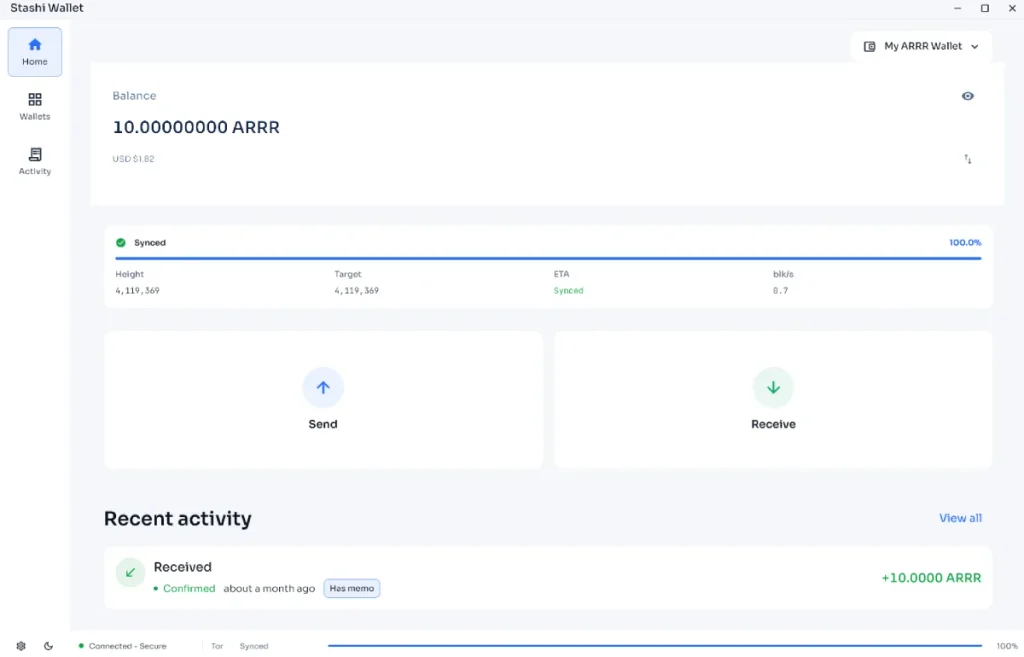
Stashi: A Modular Blockchain Environment
Calling Stashi a crypto wallet is somewhat accurate, but it doesn't fully describe what it is. A traditional wallet is primarily a secure interface for managing keys, addresses, balances and transactions. Stashi takes a broader approach.
It acts as a harness, providing a common environment that can contain and coordinate multiple wallet technologies and other blockchain functionality within a single application.
The wallet is therefore one component of the system, rather than the entire system itself. Stashi is designed to bring these components together behind a unified interface, allowing users to interact with different blockchain technologies without needing a separate application for each one.
As the platform develops, additional technologies and functionality can be integrated into the same environment, extending what can be done without fundamentally changing the user experience.
This distinction matters because the harness model is more extensible than the traditional wallet model. Instead of building an application around a single wallet implementation, Stashi provides the framework in which wallets, trading functionality and other blockchain services can coexist. The result is closer to a modular blockchain environment than a conventional crypto wallet.
Faster, Multi-Wallet, Tor, Trustless and Much More
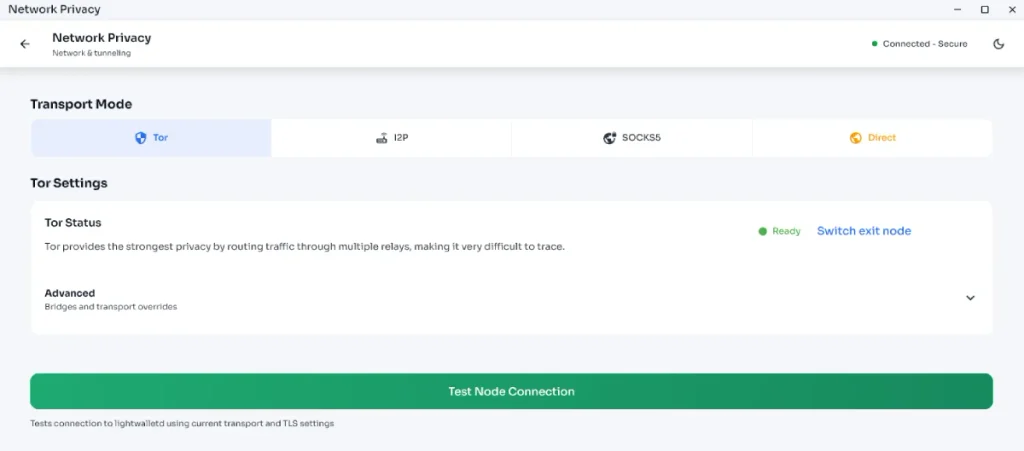
Stashi brings users a faster and more reliable synchronisation experience. Embedded Tor and I2P connectivity adds an additional network privacy enhancement to the wallet. Stashi supports multiple wallets where users can create, restore, and switch between separate ARRR wallets inside the application.
Stashi works for both the upcoming new Ironwood-shielded transactions as well as traditional Sapling-shielded transactions, and users can receive, scan, manage, and spend from either shielded pool. Pirate Chain's upgrade for Ironwood, which will activate a new trustless shielded pool, is set to launch on 3rd of October 2026, 19:00 UTC.
A new addition to Pirate Chain wallets is multilingual support, with Stashi supporting 16 different languages along with English. In addition, eight recovery-phrase languages are supported for English, simplified and traditional Chinese, French, Italian, Japanese, Korean, and Spanish word lists.
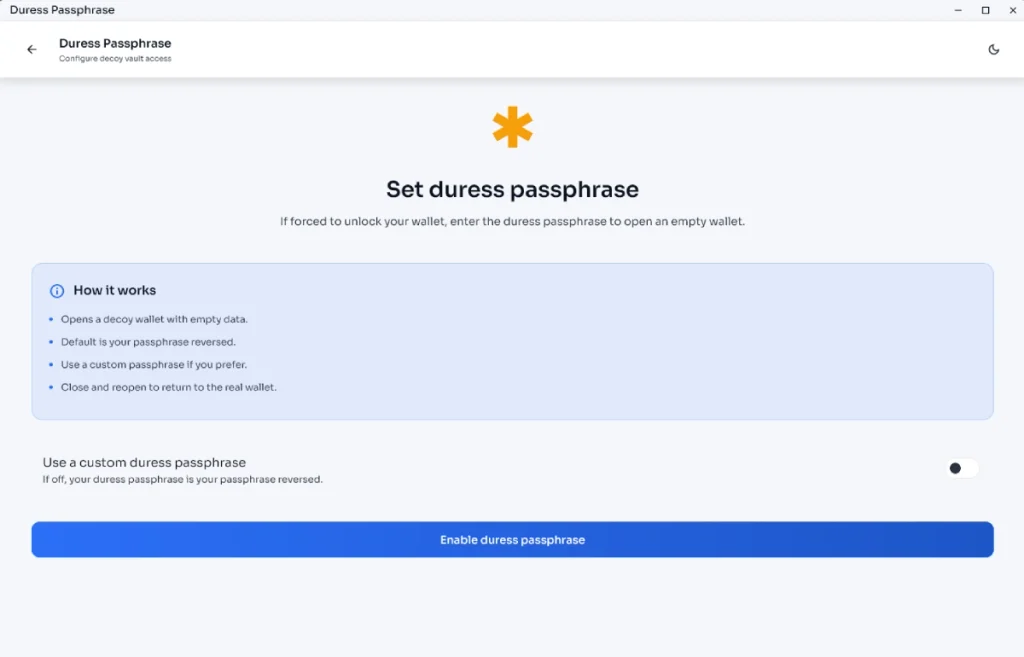
For security, Stashi gives a passphrase-protected wallet with sensitive-action approval. Also, new to Pirate Chain is the duress passphrase for users to open a believable decoy wallet instead of their real wallet.
The Stashi harness also provides users with the ability to prove a single Payment Disclosure, a new feature that was added to Pirate Chain for Ironwood. Users will be able share or receive and verify a single transaction disclosure key to prove payments without sharing the entire wallet history.
Payment Disclosure for single transactions is now available for Sapling transactions and will be available for Ironwood transactions when Ironwood launches on the 3rd of October 2026.
The Stashi harness is open source and published under the MIT License. Its build, packaging, and verification scripts are available for inspection on the Unified Light Harness Github.
A Unified Multi-Platform Harness
Stashi is supported on desktop on Linux, Windows, macOS. Users can download the wallet for their platform from the Unified Light Harness Github.
Android users can also download the APK from the Unified Light Harness Github. Most users should download the android-v8 version. (Use the android-v7 version only if needed on an older 32-bit Android device.)
The Android version will be submitted to the Play Store by the Pirate Chain Foundation development team and may be available to download from there once accepted.
Stashi's Unified Harness React Native SDK also enables the integration of third-party ARRR wallets, such mobile wallets on iOS. Users on iOS can download the latest version of third-party wallets that support ARRR on the Pirate Chain Wallets page.
Light Harness Consolidation
The new Stashi unified harness will be the official and supported Pirate Chain (ARRR) light harness. Users who are still on the older PirateWallet-Lite for desktop and the older application for Android should download the new Stashi unified harness to use as their ARRR light harness.
Older light wallets will be discontinued and archived in early October 2026. Users of older light wallets should download and install the new unified light harness with Supernova sync. (Users should be able to open older light harness applications to view and extract seed phrases and private keys.)
The new Stashi Keys & Addresses area:
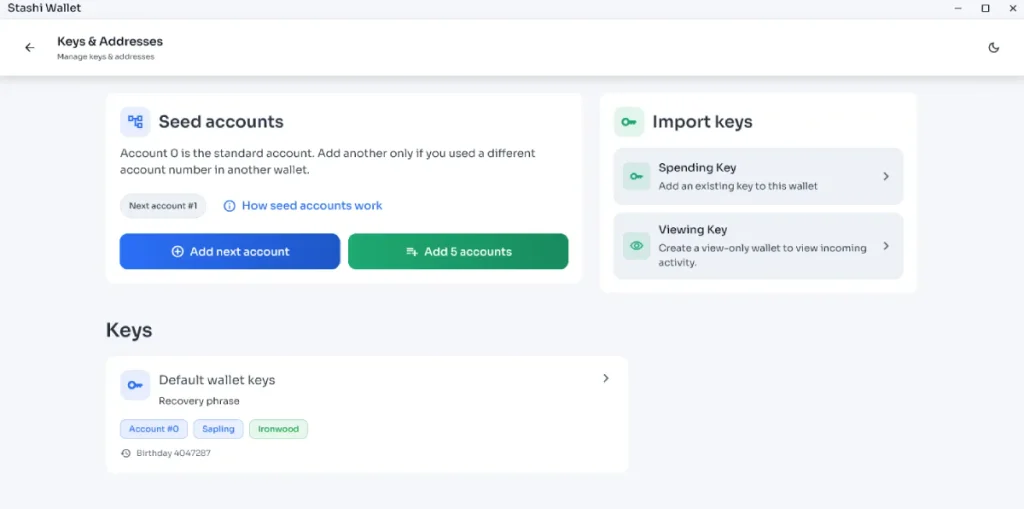
Be sure to keep your seed phrase safe. Users can restore from seed using their seed phrase in the Stashi harness or restore from private key. By moving to the Stashi unified harness, users can also take advantage of the fast new Supernova Sync speeds.
The Fastest zk-SNARKs Sync in the World
Supernova is the unified harness's new - world leading - high-throughput synchronisation engine, featuring ultra fast cached rescans as well as adaptive device profiles and memory-bounded processing.
I tested our core/sync engine against Zcash's brand new AGPL-3 licensed sync engine called Slipstream. Pirate Chain now has the best & fastest zk-SNARKs sync engine in the world!
~ Supernova sync core developer
Supernova Lightspeed Sync Technology Tested
| Metric | Supernova | Zcash |
|---|---|---|
| Sync Range | 3,500,000 – 4,082,830 | 3,365,302 – 3,442,367 |
| Block Count | 582,831 | 77,066 |
| Shielded Actions | 313,373 | 313,380 |
| Encoded Data | 101.4 MB | 63.87 MB |
| End-to-End Sync Time | 25.391 seconds | 40.396 seconds |
| Sync Pipeline | 21.032 seconds | 38.223 seconds |
| Actions per Second | 12,342 | 7,758 |
Stashi's Unified Harness React Native plugin and SDKs allow third-party ARRR wallets to take advantage of Supernova's fast synchronisation speeds.
Stay tuned for additional details about the Supernova sync engine.

Stashi Features
There is a lot more packed into the Stashi harness. A single transaction can pay up to 50 recipients, each with its own amount and private memo. Watch-only wallets built from viewing keys can monitor funds while spending keys stay on another device.
Receive addresses rotate automatically once they have been used, and consolidation and sweep tools keep note fragmentation under control.
Stashi is just as careful about trust. It probes curated light servers and picks healthy endpoints on its own, cross-checks historical blocks against more than one agreeing server, and includes a Verify Build tool that checks the release tag, the official signing key, and the hash of the file on disk before you trust a download.
That is a small slice of the Stashi harness. Browse the full feature list in the technical specification below.
Stashi Harness Feature Bank
85 features across 6 feature banks
- 1New wallets use a 24-word recovery phrase with a guided backup and confirmation flow.
- 2Existing 12-word, 18-word, and 24-word recovery phrases can be restored for compatibility with older wallets.
- 3Users can receive, scan, manage, and spend from either shielded pool.
- 4A single transaction can include as many as 50 recipients, each with its own amount and memo.
- 5Each recipient can receive a private text memo of up to 512 bytes.
- 6Before signing, the wallet shows recipients, amounts, fees, spend source, and any change coming back.
- 7Auto mode can choose spendable notes across all eligible wallet keys.
- 8Users can select a specific key group or address when they want tighter control over which funds are used.
- 9Low, standard, high, and custom fee choices are available, with warnings for fees that look unsafe or unusual.
- 10Half-balance and maximum-balance shortcuts make common sends quicker to prepare.
- 11Payment details can be scanned with the camera or read from a saved image.
- 12Receive QR codes can include an address, requested amount, and private memo.
- 13The activity view and transaction details show status, confirmations, amounts, fees, memos, recipients, and transaction IDs when available.
- 14The displayed balance can be hidden with one tap.
- 15ARRR value can be shown in Bitcoin or any of 20 supported fiat currencies, and the user can switch which value is shown first.
- 16Users can create, restore, rename, remove, and switch between separate wallets inside the same app.
- 17The Keys and Addresses screen can add the next ZIP-32 account or the next five accounts from the active recovery phrase, then scan them for history.
- 18Every seed account carries its own keys for both supported shielded pools.
- 19Sapling and Ironwood spending keys can be added to an existing wallet and scanned from a chosen birthday height.
- 20Sapling and Ironwood viewing keys can be added for wallets that need visibility without spending access.
- 21A separate watch-only wallet can monitor incoming activity while keeping spending keys on another device.
- 22Each key group has its own addresses, balances, export options, consolidation tools, and sweep tools where its capabilities allow them.
- 23Users can create a fresh Sapling or Ironwood address for a selected key group.
- 24After an address receives funds, Stashi prepares a new receive address while continuing to watch the old one.
- 25Receive addresses can be sorted, labeled, color-tagged, pinned, shared, or archived. Archived addresses remain monitored.
- 26Saved recipients support labels, notes, favorites, color tags, search, recent-use tracking, QR import, and one-tap send setup.
- 27The wallet can combine eligible unlabeled notes during ordinary sends to reduce future note fragmentation.
- 28A user can preview and consolidate funds for a specific key and shielded pool.
- 29A key's spendable balance can be swept to a chosen wallet address or another destination after review.
- 30The wallet can estimate, save, or change the starting block used for recovery.
- 31Users can rebuild wallet state from the birthday height or another selected height when recovery is needed.
- 32English, simplified and traditional Chinese, French, Italian, Japanese, Korean, and Spanish word lists are supported.
- 33Tor is the default transport and runs inside the wallet, so a separate Tor client is not required.
- 34A user can request a new Tor route from the Network Privacy screen.
- 35Stashi can start an embedded I2P router with a fresh temporary identity for each app session.
- 36Users can route wallet traffic through their own compatible proxy.
- 37A direct connection is available for users who choose speed or simplicity over IP privacy, with a clear warning about the tradeoff.
- 38Auto mode probes curated light servers and chooses healthy endpoints without making the user manage a server list.
- 39Historical ranges can be downloaded from more than one agreeing server, then reordered and checked as one continuous chain.
- 40Onion services stay first when Tor is selected, while approved TLS clearnet servers can still be reached through Tor when needed.
- 41Users can choose a preset server or enter their own lightwalletd endpoint.
- 42Advanced users can pin a server certificate identity and test the live connection before trusting it.
- 43Price feeds, GitHub verification checks, and desktop update checks can be turned off without disabling light-server sync.
- 44The app shows the active route, endpoint health, tunnel state, and connection errors in plain language.
- 45Viewing keys stay on the device while compact chain data is trial-decrypted locally.
- 46A Rust sync pipeline overlaps downloading, local trial decryption, commitment-tree work, and storage without allowing competing database writers.
- 47A representative development run processed roughly 583,000 cached blocks in the low-20-second range. Device, storage, block density, and cache state still matter.
- 48Batch size, worker use, and memory targets adjust to the device instead of treating a phone like a desktop computer.
- 49Queues are limited by the actual bytes received, which helps prevent a busy shielded range from consuming unbounded memory.
- 50The downloader keeps a validated stream moving and can preserve a good prefix if a server fails partway through a range.
- 51Cached protobuf records carry an integrity checksum and are structurally checked before reuse.
- 52Damaged or malformed cached ranges are discarded and downloaded again instead of being treated as wallet history.
- 53Closing the wallet, cancelling a scan, switching wallets, or restarting after a crash does not leave a hidden writer behind.
- 54Sapling and Ironwood rewind together to a shared valid checkpoint and replay from there when the chain reorganizes.
- 55Notes, transactions, commitment trees, checkpoints, and sync cursors become visible as one ordered database transition.
- 56Android WorkManager and iOS background tasks can run short maintenance syncs and deeper scheduled syncs when the operating system permits them.
- 57Background work can rotate among eligible wallets instead of keeping only one wallet current.
- 58The app distinguishes preparation, fetching, scanning, storage, repair, and final verification, then reports speed from completed work.
- 59Local wallet data is protected by the app passphrase, which is required to unlock the wallet.
- 60Supported devices can use system biometrics for quicker access, with the passphrase kept as a fallback.
- 61Sending funds, changing security settings, and revealing recovery material require fresh authorization.
- 62A separate passphrase can open a believable decoy wallet instead of the real wallet.
- 63Seed and key screens request screenshot and screen-recording protection on supported platforms.
- 64Sensitive copied values are cleared after a short timer, and Stashi avoids erasing unrelated clipboard content copied afterward.
- 65Revealing a recovery phrase uses warnings, authentication, and a deliberate confirmation flow.
- 66The app uses the operating system's protected key store for supported secrets and security preferences.
- 67Verify Build checks the exact release tag, the official wallet release key identity, the signed checksum manifest, and the local artifact hash.
- 68Release bundles include SHA-256 manifests, detached PGP signatures, and the public verification key.
- 69Downloaded updates must match published checksums. Windows and macOS add platform signature checks before replacement or launch.
- 70The release process can publish software bills of materials, provenance files, and reproducible unsigned builds for comparison.
- 71Debug logging can be enabled for troubleshooting, and exported logs redact recognized secrets before sharing.
- 72Desktop builds prevent two copies of the wallet from opening the same local state at once.
- 73The project produces release builds for Windows, Linux, macOS, Android, and iOS.
- 74Linux users can choose AppImage, Flatpak, or Debian package formats.
- 75Phone, tablet, compact landscape, and desktop layouts are tested separately so controls remain reachable at different sizes.
- 76Desktop builds use a persistent side rail, wide content panes, a live status bar, and window-aware layouts.
- 77Phones use bottom navigation, adaptive sheets, camera scanning, safe-area handling, and touch-sized actions.
- 78English, Arabic, simplified Chinese, Dutch, French, German, Hindi, Indonesian, Italian, Japanese, Korean, Portuguese, Russian, Spanish, Turkish, and Urdu are included.
- 79Arabic and Urdu switch the interface to the correct reading direction.
- 80Important controls include screen-reader labels, keyboard and focus behavior, large-text layouts, high-contrast tokens, and reduced-animation handling.
- 81Users can choose a theme or let Stashi follow the operating system.
- 82Balances can be paired with Bitcoin plus 20 fiat currencies, including major global and regional options.
- 83The wallet is published under the MIT License, and its build, packaging, and verification scripts are available for inspection.
- 84The Flutter app, command-line tools, native SDKs, React Native package, and Qortal integrations share the same wallet service instead of reimplementing core behavior.
- 85The repository includes Android, iOS, React Native, native FFI, CLI, and Qortal deliverables for other products that need Pirate Chain support.
Private payments and everyday use...
New 24-word wallets
Legacy seed recovery
Sapling and Ironwood payments
Multi-recipient sends
Private memos
Clear transaction review
Automatic spend selection
Manual spend control
Fee controls
Quick amount controls
QR scanning
Shareable payment requests
Detailed activity
Balance privacy
Fiat and BTC values
Keys, addresses, and recovery
Multiple wallets
Additional seed accounts
Sapling and Ironwood account keys
Spending-key import
Viewing-key import
Watch-only wallets
Per-key controls
Manual address generation
Automatic address rotation
Address history
Address book
Automatic note consolidation
Manual consolidation
Key sweeping
Birthday height controls
Guided rescans
Eight recovery-phrase languages
Network privacy and connection control
Built-in Tor
Tor exit rotation
Built-in I2P
Custom SOCKS5 proxy
Direct mode
Automatic server selection
Validated multi-server sync
Route-aware endpoint choices
Manual node selection
TLS certificate pinning
Outbound API controls
Connection diagnostics
Local shielded scanning
Fast sync with careful recovery
Supernova sync engine
Very fast cached rescans
Adaptive device profiles
Memory-bounded processing
Continuous streaming
Checksummed compact-block cache
Automatic cache repair
Interruption-safe sync
Reorg recovery
Crash-safe state updates
Mobile background sync
Fair multi-wallet maintenance
Honest progress reporting
Local security and release trust
Passphrase-protected wallet
Biometric unlock
Sensitive-action approval
Duress passphrase
Protected recovery screens
Timed clipboard clearing
Guarded seed export
Native secure storage
In-app PGP verification
Signed release downloads
Verified desktop updates
Inspectable release records
Redacted support logs
Single desktop instance
Design, access, and platform reach
Five major platforms
Flexible Linux packages
Responsive layouts
Desktop-first navigation where it helps
Mobile-first controls where they help
Sixteen interface languages
Right-to-left layouts
Accessible interaction
Light, dark, and system themes
Twenty-one display currencies
Open source
Shared Rust wallet core
Developer-friendly integration
Complete Stashi User Guide
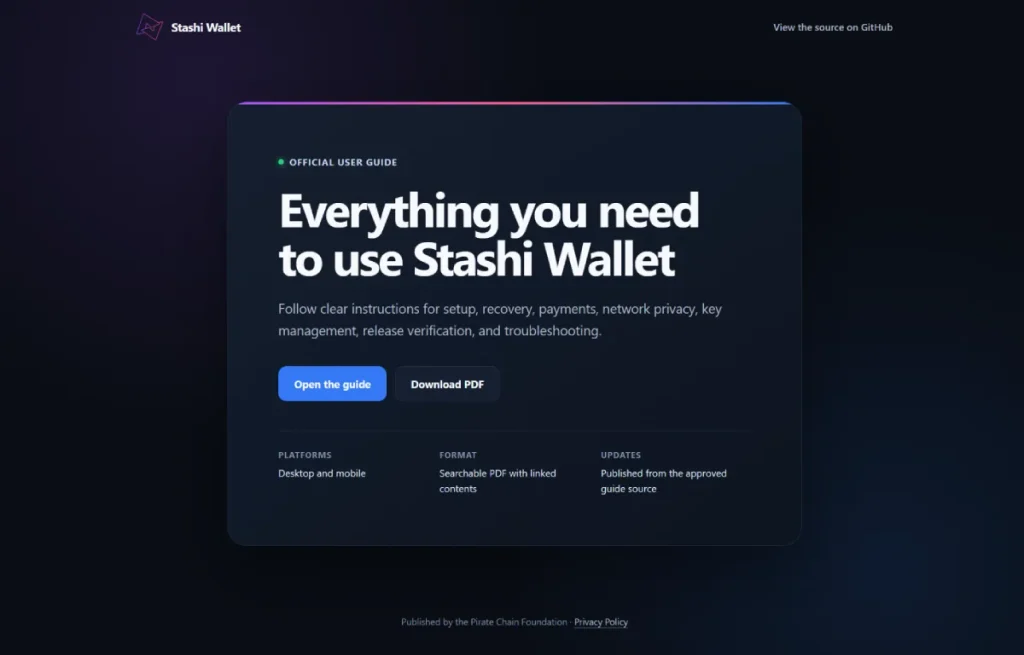
The Pirate Chain Foundation has created a comprehensive Stashi harness user guide to help you get the most out of Stashi and learn how to use all of its new features. If you need any additional assistance, you can contact the core developers through the user support channels in the Pirate Chain Discord server.
About Pirate Chain
Pirate Chain (ARRR) is a privacy coin that is always shielded using zero-knowledge proofs built on zk-SNARK technology, with no optional transparency. Launched in 2018, Pirate Chain moved to Ironwood in 2026 to become one of the only privacy coins running a fully trustless, formally verified shielded pool.
Media Contact
Article Credits
☑️ AmyV ☑️ QuirkyRobots